Facts about Heredity and Evolution
Heredity is the passing on of traits from parents to their offspring, either through asexual reproduction or sexual reproduction, the offspring cells or organisms acquire the genetic information of their parents. Through heredity, variations between individuals can accumulate and cause species to evolve by natural selection. The study of heredity in biology is genetics.
Variation- The difference in the characters among the individual of a species is called variations.
Ex. height of a organisms.
Accumulation of variations -
The significance of variations shows up only if it continues to be inherited by the offspring for several generations.
Ex. Suppose a bacterium has a variation due to which it can tolerate a little higher temperature than the other one . Now this variation will go on accumulating in the successive generations of this bacterium. And this will ultimately give rise to a variant of bacterium which will be highly heat resistant and able to survive even at very high temperature.
The great advantage of variations to a species is that it increases the chance of its survival in a changing environment.
Ex. The accumulation of heat resistant variation in some bacteria will ensure its survival even when the temperature in its environment rise to much.
Now how these characters or traits appears ?
These all are done by genes . There are thousands of genes on a chromosome that contains a specific trait of an organisms.
Genes for controlling the same characteristics of an organisms can be of two types -
1> Dominant gene
The gene which decides the appearance of an organisms even in the presence of an alternative gene.
2>Reccessive gene
The gene which can decide the appearance of an organisms only in the presence of another identical gene.
ATTENTION! - A single Reccessive gene cannot decide the appearance of an organisms.
Thanks for visit .
A blog by Rishabh Mishra.☺
Variation- The difference in the characters among the individual of a species is called variations.
Ex. height of a organisms.
Accumulation of variations -
The significance of variations shows up only if it continues to be inherited by the offspring for several generations.
Ex. Suppose a bacterium has a variation due to which it can tolerate a little higher temperature than the other one . Now this variation will go on accumulating in the successive generations of this bacterium. And this will ultimately give rise to a variant of bacterium which will be highly heat resistant and able to survive even at very high temperature.
The great advantage of variations to a species is that it increases the chance of its survival in a changing environment.
Ex. The accumulation of heat resistant variation in some bacteria will ensure its survival even when the temperature in its environment rise to much.
Now how these characters or traits appears ?
These all are done by genes . There are thousands of genes on a chromosome that contains a specific trait of an organisms.
Genes for controlling the same characteristics of an organisms can be of two types -
1> Dominant gene
The gene which decides the appearance of an organisms even in the presence of an alternative gene.
2>Reccessive gene
The gene which can decide the appearance of an organisms only in the presence of another identical gene.
ATTENTION! - A single Reccessive gene cannot decide the appearance of an organisms.
Gregor Mendel: father of genetics

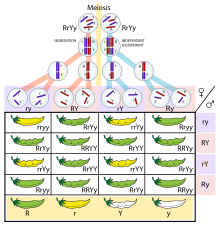
Table showing how the genes exchange according to segregation or independent assortment during meiosis and how this translates into Mendel's laws
The idea of particulate inheritance of genes can be attributed to the Moravian monk Gregor Mendel who published his work on pea plants in 1865. However, his work was not widely known and was rediscovered in 1901. It was initially assumed that Mendelian inheritance only accounted for large (qualitative) differences, such as those seen by Mendel in his pea plants—and the idea of additive effect of (quantitative) genes was not realised until R. A. Fisher's (1918) paper, "The Correlation Between Relatives on the Supposition of Mendelian Inheritance" Mendel's overall contribution gave scientists a useful overview that traits were inheritable. His pea plant demonstration became the foundation of the study of Mendelian Traits. These traits can be traced on a single locus.
Modern development of genetics and heredity
In the 1930s, work by Fisher and others resulted in a combination of Mendelian and biometric schools into the modern evolutionary synthesis. The modern synthesis bridged the gap between experimental geneticists and naturalists; and between both and palaeontologists, stating that:
- All evolutionary phenomena can be explained in a way consistent with known genetic mechanisms and the observational evidence of naturalists.
- Evolution is gradual: small genetic changes, recombination ordered by natural selection. Discontinuities amongst species (or other taxa) are explained as originating gradually through geographical separation and extinction (not saltation).
- Selection is overwhelmingly the main mechanism of change; even slight advantages are important when continued. The object of selection is the phenotype in its surrounding environment. The role of genetic drift is equivocal; though strongly supported initially by Dobzhansky, it was downgraded later as results from ecological genetics were obtained.
- The primacy of population thinking: the genetic diversity carried in natural populations is a key factor in evolution. The strength of natural selection in the wild was greater than expected; the effect of ecological factors such as niche occupation and the significance of barriers to gene flow are all important.
The idea that speciation occurs after populations are reproductively isolated has been much debated.[37] In plants, polyploidy must be included in any view of speciation. Formulations such as 'evolution consists primarily of changes in the frequencies of alleles between one generation and another' were proposed rather later. The traditional view is that developmental biology ('evo-devo') played little part in the synthesis, but an account of Gavin de Beer's work by Stephen Jay Gould suggests he may be an exception.[38]
Almost all aspects of the synthesis have been challenged at times, with varying degrees of success. There is no doubt, however, that the synthesis was a great landmark in evolutionary biology.[39] It cleared up many confusions, and was directly responsible for stimulating a great deal of research in the post-World War II era.
Trofim Lysenko however caused a backlash of what is now called Lysenkoism in the Soviet Union when he emphasised Lamarckian ideas on the inheritance of acquired traits. This movement affected agricultural research and led to food shortages in the 1960s and seriously affected the USSR.[40]
There is growing evidence that there is transgenerational inheritance of epigenetic changes in humans[41] and other animals.[42]
Common genetic disorders
- Down syndrome
- sickle cell disease
- Phenylketonuria (PKU)
- Haemophilia[34]
- Evolution is change in the heritablecharacteristics of biological populations over successive generations.[1][2] These characteristics are the expressions of genesthat are passed on from parent to offspring during reproduction. Different characteristics tend to exist within any given population as a result of mutation, genetic recombination and other sources of genetic variation.[3] Evolution occurs when evolutionary processes such as natural selection (including sexual selection) and genetic drift act on this variation, resulting in certain characteristics becoming more common or rare within a population.[4] It is this process of evolution that has given rise to biodiversity at every level of biological organisation, including the levels of species, individual organisms and molecules.[5]The scientific theory of evolution by natural selection was proposed by Charles Darwinand Alfred Russel Wallace in the mid-19th century and was set out in detail in Darwin's book On the Origin of Species (1859).[6]Evolution by natural selection was first demonstrated by the observation that more offspring are often produced than can possibly survive. This is followed by three observable facts about living organisms: 1) traits vary among individuals with respect to their morphology, physiology and behaviour (phenotypic variation), 2) different traits confer different rates of survival and reproduction (differential fitness) and 3) traits can be passed from generation to generation (heritability of fitness).[7] Thus, in successive generations members of a population are more likely to be replaced by the progenies of parents with favourable characteristics that have enabled them to survive and reproduce in their respective environments. In the early 20th century, other competing ideas of evolution such as mutationism and orthogenesis were refuted as the modern synthesis reconciled Darwinian evolution with classical genetics, which established adaptive evolution as being caused by natural selection acting on Mendelian genetic variation.[8]All life on Earth shares a last universal common ancestor (LUCA)[9][10][11] that lived approximately 3.5–3.8 billion years ago.[12]The fossil record includes a progression from early biogenic graphite,[13] to microbial matfossils,[14][15][16] to fossilised multicellular organisms. Existing patterns of biodiversity have been shaped by repeated formations of new species (speciation), changes within species (anagenesis) and loss of species (extinction) throughout the evolutionary history of life on Earth.[17] Morphological and biochemical traits are more similar among species that share a more recent common ancestor, and can be used to reconstruct phylogenetic trees.Evolutionary biologists have continued to study various aspects of evolution by forming and testing hypotheses as well as constructing theories based on evidence from the field or laboratory and on data generated by the methods of mathematical and theoretical biology. Their discoveries have influenced not just the development of biologybut numerous other scientific and industrial fields, including agriculture, medicine and computer science.
- Darwin's Theory Of
Darwin's Theory Of Evolution
Darwin's Theory of Evolution is the widely held notion that all life is related and has descended from a common ancestor: the birds and the bananas, the fishes and the flowers -- all related. Darwin's general theory presumes the development of life from non-life and stresses a purely naturalistic (undirected) "descent with modification". That is, complex creatures evolve from more simplistic ancestors naturally over time. In a nutshell, as random genetic mutations occur within an organism's genetic code, the beneficial mutations are preserved because they aid survival -- a process known as "natural selection." These beneficial mutations are passed on to the next generation. Over time, beneficial mutations accumulate and the result is an entirely different organism (not just a variation of the original, but an entirely different creature).Darwin's Theory of Evolution - Natural Selection
While Darwin's Theory of Evolution is a relatively young archetype, the evolutionary worldview itself is as old as antiquity. Ancient Greek philosophers such as Anaximander postulated the development of life from non-life and the evolutionary descent of man from animal. Charles Darwin simply brought something new to the old philosophy -- a plausible mechanism called "natural selection." Natural selection acts to preserve and accumulate minor advantageous genetic mutations. Suppose a member of a species developed a functional advantage (it grew wings and learned to fly). Its offspring would inherit that advantage and pass it on to their offspring. The inferior (disadvantaged) members of the same species would gradually die out, leaving only the superior (advantaged) members of the species. Natural selection is the preservation of a functional advantage that enables a species to compete better in the wild. Natural selection is the naturalistic equivalent to domestic breeding. Over the centuries, human breeders have produced dramatic changes in domestic animal populations by selecting individuals to breed. Breeders eliminate undesirable traits gradually over time. Similarly, natural selection eliminates inferior species gradually over time.Darwin's Theory of Evolution - Slowly But Surely...
Darwin's Theory of Evolution is a slow gradual process. Darwin wrote, "…Natural selection acts only by taking advantage of slight successive variations; she can never take a great and sudden leap, but must advance by short and sure, though slow steps. Thus, Darwin conceded that, "If it could be demonstrated that any complex organ existed, which could not possibly have been formed by numerous, successive, slight modifications, my theory would absolutely break down." Such a complex organ would be known as an "irreducibly complex system". An irreducibly complex system is one composed of multiple parts, all of which are necessary for the system to function. If even one part is missing, the entire system will fail to function. Every individual part is integral. Thus, such a system could not have evolved slowly, piece by piece. The common mousetrap is an everyday non-biological example of irreducible complexity. It is composed of five basic parts: a catch (to hold the bait), a powerful spring, a thin rod called "the hammer," a holding bar to secure the hammer in place, and a platform to mount the trap. If any one of these parts is missing, the mechanism will not work. Each individual part is integral. The mousetrap is irreducibly complex.Darwin's Theory of Evolution - A Theory In Crisis
Darwin's Theory of Evolution is a theory in crisis in light of the tremendous advances we've made in molecular biology, biochemistry and genetics over the past fifty years. We now know that there are in fact tens of thousands of irreducibly complex systems on the cellular level. Specified complexity pervades the microscopic biological world. Molecular biologist Michael Denton wrote, "Although the tiniest bacterial cells are incredibly small, weighing less than 10-12 grams, each is in effect a veritable micro-miniaturized factory containing thousands of exquisitely designed pieces of intricate molecular machinery, made up altogether of one hundred thousand million atoms, far more complicated than any machinery built by man and absolutely without parallel in the non-living world."
And we don't need a microscope to observe irreducible complexity. The eye, the ear and the heart are all examples of irreducible complexity, though they were not recognized as such in Darwin's day. Nevertheless, Darwin confessed, "To suppose that the eye with all its inimitable contrivances for adjusting the focus to different distances, for admitting different amounts of light, and for the correction of spherical and chromatic aberration, could have been formed by natural selection, seems, I freely confess, absurd in the highest degree."
Footnotes:- Charles Darwin, "On the Origin of Species by Means of Natural Selection, or the Preservation of Favoured Races in the Struggle for Life," 1859, p. 162.
- Ibid. p. 158.
- Michael Behe, "Darwin's Black Box," 1996.
- "Unlocking the Mystery of Life," documentary by Illustra Media, 2002.
- Michael Denton, "Evolution: A Theory in Crisis," 1986, p. 250.
- Charles Darwin, "On the Origin of Species by Means of Natural Selection, or the Preservation of Favoured Races in the Struggle for Life," 1859, p. 155.
If you have any questions , write it in the comment box . If you like it than share it.
Thanks for visit .
A blog by Rishabh Mishra.☺


Comments
Post a Comment