Mono hybrid and Di hybrid crosses
Monohybrid cross
This cross is based on the first law of genetics i.e Law of Segregation. A monohybrid cross is a mating between two organisms with different variations at one genetic chromosome of interest. The character(s) being studied in a monohybrid cross are governed by two or multiple variations for a single locus. A cross between two parents possessing a pair of contrasting characters is known as monohybrid cross. To carry out such a cross, each parent is chosen to be homozygous or true breeding for a given trait (locus). When a cross satisfies the conditions for a monohybrid cross, it is usually detected by a characteristic distribution of second-generation (F2) offspring that is sometimes called the monohybrid ratio.

Figure 1: Inheritance pattern of dominant (red) and recessive (white) phenotypes when each parent (1) is homozygous for either the dominant or recessive trait. All members of the F1generation are heterozygous and share the same dominant phenotype (2), while the F2 generation exhibits a 6:2 ratio of dominant to recessive phenotypes (3).
This cross is based on the first law of genetics i.e Law of Segregation. A monohybrid cross is a mating between two organisms with different variations at one genetic chromosome of interest. The character(s) being studied in a monohybrid cross are governed by two or multiple variations for a single locus. A cross between two parents possessing a pair of contrasting characters is known as monohybrid cross. To carry out such a cross, each parent is chosen to be homozygous or true breeding for a given trait (locus). When a cross satisfies the conditions for a monohybrid cross, it is usually detected by a characteristic distribution of second-generation (F2) offspring that is sometimes called the monohybrid ratio.

Figure 1: Inheritance pattern of dominant (red) and recessive (white) phenotypes when each parent (1) is homozygous for either the dominant or recessive trait. All members of the F1generation are heterozygous and share the same dominant phenotype (2), while the F2 generation exhibits a 6:2 ratio of dominant to recessive phenotypes (3).
Usage
Generally, the monohybrid cross is used to determine the dominance relationship between two alleles. The cross begins with the parental generation. One parent is homozygous for one allele, and the other parent is homozygous for the other allele. The offspring make up the first filial (F1) generation. Every member of the F1 generation is heterozygous and the phenotype of the F1 generation expresses the dominant trait.Crossing two members of the F1 generation produces the second filial (F2) generation. Probability theory predicts that three quarters of the F2 generation will have the dominant allele's phenotype. And the remaining quarter of the F2s will have the recessive allele's phenotype. This predicted 3:1 phenotypic ratio assumes Mendelian inheritance.
This cross was originally used by biologist Gregor Mendel, who crossed two pea plants to obtain a hybrid variety and discovered the dominance relationships between alleles of several genes. Mendel has considered one alleleomorph character for his first experiment that is colour of red and white length of plant-tall and dwarf.
Generally, the monohybrid cross is used to determine the dominance relationship between two alleles. The cross begins with the parental generation. One parent is homozygous for one allele, and the other parent is homozygous for the other allele. The offspring make up the first filial (F1) generation. Every member of the F1 generation is heterozygous and the phenotype of the F1 generation expresses the dominant trait.Crossing two members of the F1 generation produces the second filial (F2) generation. Probability theory predicts that three quarters of the F2 generation will have the dominant allele's phenotype. And the remaining quarter of the F2s will have the recessive allele's phenotype. This predicted 3:1 phenotypic ratio assumes Mendelian inheritance.
This cross was originally used by biologist Gregor Mendel, who crossed two pea plants to obtain a hybrid variety and discovered the dominance relationships between alleles of several genes. Mendel has considered one alleleomorph character for his first experiment that is colour of red and white length of plant-tall and dwarf.
Mendel's experiment
Gregor Mendel (1822–1884) was an Austrian monk who theorized basic rules of inheritance.From 1858 to 1866, he bred garden peas Pisum sativum in his monastery garden and analyzed the offspring of these matings. The garden pea was chosen as an experimental organism because many varieties were available that bred true for qualitative traits and their pollination could be manipulated. The seven variable characteristics Mendel investigated in pea plants were
- seed texture (round vs wrinkled)
- seed color (yellow vs green)
- flower color (white vs purple)
- growth habit (tall vs dwarf)
- pod shape (pinched or inflated)
- pod color (green vs yellow)
- flower position (axial or terminal)
.[6] Peas are normally self-pollinated because the stamens and carpels are enclosed within the petals. By removing the stamens from unripe flowers, Mendel could brush pollen from another variety on the carpels when they ripenedEdit
Gregor Mendel (1822–1884) was an Austrian monk who theorized basic rules of inheritance.From 1858 to 1866, he bred garden peas Pisum sativum in his monastery garden and analyzed the offspring of these matings. The garden pea was chosen as an experimental organism because many varieties were available that bred true for qualitative traits and their pollination could be manipulated. The seven variable characteristics Mendel investigated in pea plants were
- seed texture (round vs wrinkled)
- seed color (yellow vs green)
- flower color (white vs purple)
- growth habit (tall vs dwarf)
- pod shape (pinched or inflated)
- pod color (green vs yellow)
- flower position (axial or terminal)
.[6] Peas are normally self-pollinated because the stamens and carpels are enclosed within the petals. By removing the stamens from unripe flowers, Mendel could brush pollen from another variety on the carpels when they ripenedEdit
Dihybrid cross
Dihybrid cross is a cross between two different lines/genes that differ in two observed traits. In the Mendelian sense, between the alleles of both these loci there is a relationship of complete dominance - recessive. In the example pictured to the right, RRYY/rryy parents result in F1 offspring that are heterozygous for both R and Y (RrYy).
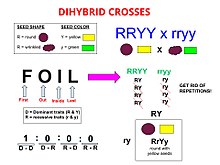
In this Dihybrid Cross, homozygous dominant traits were crossed with homozygous recessive traits. This particular cross always results in the phenotypic ratio of 1:0:0:0 meaning that the offspring will all have both dominant phenotypes but will be carriers of the recessive phenotypes.
In the name "Dihybrid cross", the "di" indicates that there are two traits involved (e.g. R and Y), the "hybrid" means that each trait has two different alleles (e.g. R and r, or Y and y), and "cross" means that there are two individuals (usually a mother and father) who are combining or "crossing" their genetic information.
The Dihybrid cross is easy to visualize using a Punnett square of dimensions 4 x 4:
The rules of meiosis, as they apply to the dihybrid, are codified in Mendel's first law and Mendel's second law, which are also called the Law of Segregation and the Law of Independent Assortment, respectively.
For genes on separate chromosomes, each allele pair showed independent segregation. If the first filial generation (F1 generation) produces four identical offspring, the second filial generation, which occurs by crossing the members of the first filial generation, shows a phenotypic (appearance) ratio of 9:3:3:1, where:
- the 9 represents the proportion of individuals displaying both dominant traits:
RRYY + 2 x RRYy + 2 x RrYY + 4 x RrYy
- the first 3 represents the individuals displaying the first dominant trait and the second recessive trait:
RRyy + 2 x Rryy
- the second 3 represents those displaying the first recessive trait and second dominant trait:
rrYY + 2 x rrYy
- the 1 represents the homozygous, displaying both recessive traits:
rryy
A blog by RISHABH MISHRA.😀
supported by Wikipedia.
Dihybrid cross is a cross between two different lines/genes that differ in two observed traits. In the Mendelian sense, between the alleles of both these loci there is a relationship of complete dominance - recessive. In the example pictured to the right, RRYY/rryy parents result in F1 offspring that are heterozygous for both R and Y (RrYy).

In this Dihybrid Cross, homozygous dominant traits were crossed with homozygous recessive traits. This particular cross always results in the phenotypic ratio of 1:0:0:0 meaning that the offspring will all have both dominant phenotypes but will be carriers of the recessive phenotypes.
In the name "Dihybrid cross", the "di" indicates that there are two traits involved (e.g. R and Y), the "hybrid" means that each trait has two different alleles (e.g. R and r, or Y and y), and "cross" means that there are two individuals (usually a mother and father) who are combining or "crossing" their genetic information.
The Dihybrid cross is easy to visualize using a Punnett square of dimensions 4 x 4:
The rules of meiosis, as they apply to the dihybrid, are codified in Mendel's first law and Mendel's second law, which are also called the Law of Segregation and the Law of Independent Assortment, respectively.
For genes on separate chromosomes, each allele pair showed independent segregation. If the first filial generation (F1 generation) produces four identical offspring, the second filial generation, which occurs by crossing the members of the first filial generation, shows a phenotypic (appearance) ratio of 9:3:3:1, where:
- the 9 represents the proportion of individuals displaying both dominant traits:
RRYY + 2 x RRYy + 2 x RrYY + 4 x RrYy - the first 3 represents the individuals displaying the first dominant trait and the second recessive trait:
RRyy + 2 x Rryy - the second 3 represents those displaying the first recessive trait and second dominant trait:
rrYY + 2 x rrYy - the 1 represents the homozygous, displaying both recessive traits:
rryy
A blog by RISHABH MISHRA.😀
supported by Wikipedia.
supported by Wikipedia.


Comments
Post a Comment